Understanding IIAR 6: Essential Guidelines for Industrial Refrigeration
Explore the key requirements and best practices outlined in IIAR 6 for maintaining industrial refrigeration systems safely and efficiently.
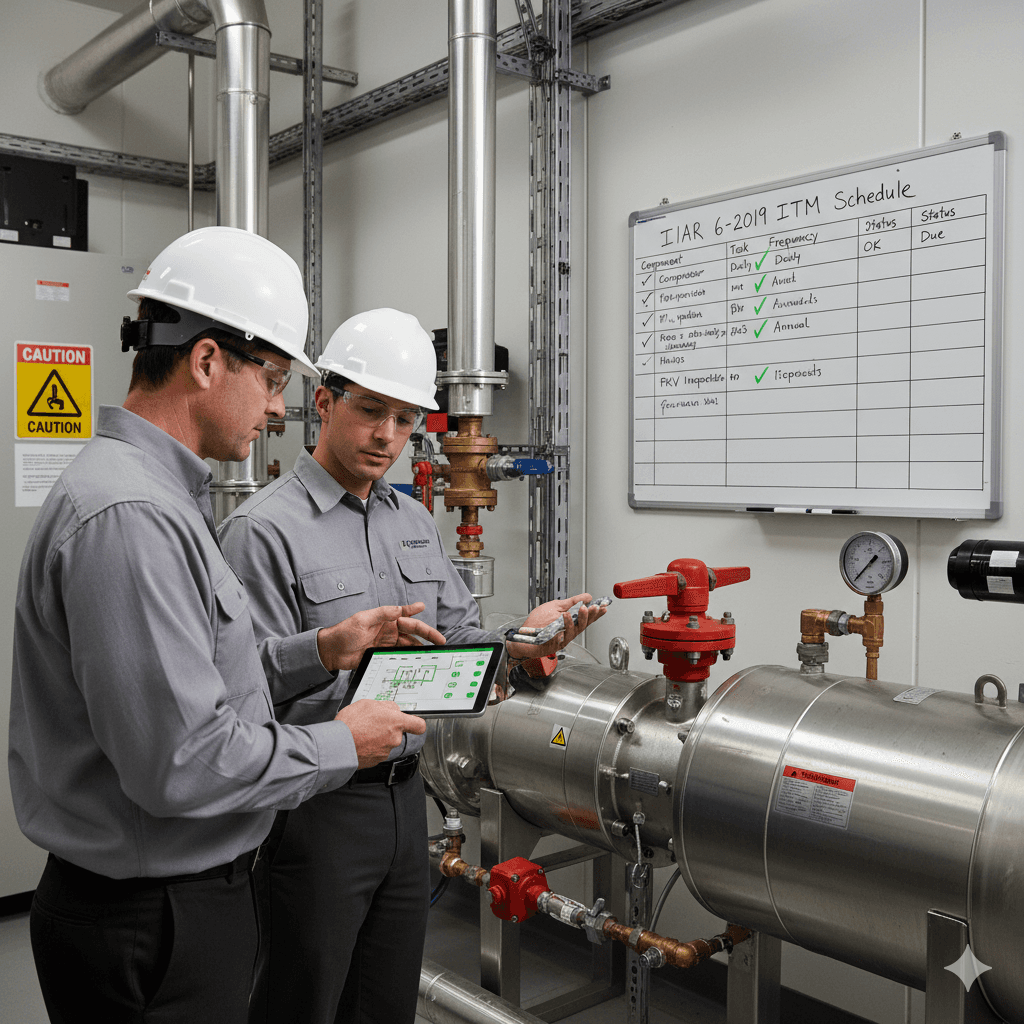
If your facility uses anhydrous ammonia for industrial refrigeration, ANSI/IIAR 6-2019 is the playbook for keeping your system safe, reliable, and compliant. The standard lays out the inspection, testing, and maintenance (ITM) tasks every closed-circuit ammonia refrigeration system needs—and how often to do them. Think of it as the maintenance backbone that supports your OSHA Process Safety Management (PSM) and EPA Risk Management Plan (RMP) programs.
What is IIAR 6-2019?
ANSI/IIAR 6-2019 is a consensus standard from the International Institute of Ammonia Refrigeration (IIAR). It establishes minimum ITM requirements for closed-circuit ammonia systems, providing a clear list of what must be inspected or tested, the frequencies, and the records you need to keep. It also clarifies management responsibilities for overseeing an ITM program.
Critically, IIAR 6 replaces legacy guidance that many plants still reference. IIAR Bulletins 109 and 110 have been discontinued; their content is now incorporated into IIAR 6 and other IIAR standards. If your procedures still cite "Bulletin 110," it's time to update.
Why IIAR 6 matters for compliance (PSM & RMP)
OSHA's PSM standard requires employers to follow recognized and generally accepted good engineering practices (RAGAGEP)—and IIAR standards are widely treated as the relevant RAGAGEP for ammonia refrigeration. OSHA's enforcement guidance and state OSHA memos explain how inspectors interpret "shall" vs. "should" in industry codes and standards, and they expect documented programs that align with RAGAGEP.
Meanwhile, the EPA's RMP guidance for ammonia refrigeration points facilities to industry standards for safe operation and maintenance. Aligning your MI/ITM with IIAR 6 closes common audit gaps.
What's inside IIAR 6 (in plain English)
While you need the standard for exact text and tables, here's how a facility manager should think about it:
Scope & structure
IIAR 6 is organized into parts and chapters. Parts 1–2 are normative (mandatory); other sections provide informative guidance, checklists, and appendices.
Build a formal ITM program
Owners must develop and implement a documented ITM program that reduces the likelihood of an ammonia release. IIAR 6 also clarifies you'll need to cross-reference other standards (e.g., IIAR 2) for certain design-specific details.
Component-specific tasks & frequencies
The standard lists tasks and frequencies (e.g., daily/weekly rounds, periodic tests, annual inspections) by equipment type—compressors, condensers, vessels, piping, valves, controls, detection, etc. It's the go-to source when someone asks "how often do we…?"
Documentation & recordkeeping
IIAR 6 explains what to document during inspections/tests and how long to keep records—a frequent audit issue. If you can't show it, you didn't do it.
Relief valve rules (hot topic)
IIAR 6 requires that pressure relief valves venting to atmosphere be replaced or recertified on a five-year time basis, with special treatment for certain internal/hydrostatic devices per the standard and manufacturer guidance. Many plants still operate under mixed practices from the Bulletin 110 era—now's the time to align.
Quick compliance checklist for facility managers
Use this as a conversation starter with your maintenance and PSM teams:
-
Adopt IIAR 6 as your RAGAGEP in writing (e.g., in your MI element). Update procedures that still cite IIAR Bulletins 109/110.
-
Map every asset (compressors, vessels, piping, PRVs, controls, detectors) to its IIAR 6 tasks and frequency. Build a master schedule.
-
Relief valves: inventory every PRV, identify discharge type (to atmosphere vs internal/hydrostatic), and schedule 5-year replacement/recertification where required. Keep certificates.
-
Rounds & inspections: formalize daily/weekly/monthly checks with sign-offs and deficiency tracking.
-
Testing & calibration: verify intervals for detectors, controls, safeties, and ESDs; document results and as-found/as-left conditions.
-
Recordkeeping: standardize what information is captured (who, what, when, results, corrections) and retention periods.
-
Integration with PSM/RMP: ensure your Mechanical Integrity procedures, training, and audits match IIAR 6; this supports both OSHA PSM and EPA RMP.
Common pitfalls we see (and how to fix them)
-
Outdated procedures referencing Bulletins 109/110 → Replace with IIAR 6 language, update forms/checklists, and retrain technicians.
-
Missing frequency logic → Build a living ITM matrix that cites the IIAR 6 table/section for each task so audits aren't opinion-based.
-
PRV confusion (internal/hydrostatic vs. atmospheric) → Classify each valve correctly and align with §13.x requirements and manufacturer instructions; retain certificates/labels.
-
Thin documentation → If your records don't show "as found/as left," test methods, or acceptance criteria, tighten your forms.
How IIAR 6 connects to the rest of your safety program
-
PSM Mechanical Integrity & RAGAGEP: Your MI procedures and inspection schedules should reflect IIAR 6 "shall" requirements; OSHA evaluates programs against recognized practices.
-
EPA RMP: RMP prevention elements (maintenance, training, compliance audits) depend on credible standards; EPA's ammonia guidance anticipates this alignment.
-
Other IIAR standards: You'll often cross-reference IIAR 2 for design and equipment criteria alongside IIAR 6 for ongoing maintenance.
FAQs (for non-engineers)
Is IIAR 6 required by law?
Not directly; however, OSHA and EPA expect you to follow RAGAGEP. Using IIAR 6 demonstrates you're operating to widely recognized standards—this is central to audit and enforcement defensibility.
Do we still use Bulletin 110 checklists?
No. They've been superseded. Update your internal documents to reflect IIAR 6 (and leverage the newer checklists and formats where appropriate).
How often do we replace pressure relief valves?
Valves relieving to atmosphere: replace or recertify every 5 years per IIAR 6. Internal/hydrostatic devices follow a different path per §13 and manufacturer instructions—classify correctly. Always verify against the standard text.
Take the next step
If your facility is due for a refresh, IR Pros can help you map your installed equipment to IIAR 6 tasks, build a master ITM calendar, standardize forms, and train your team—so your PSM/RMP audits go smoothly and your system runs safely.
IR Pros Team
Industrial Refrigeration Experts